Thursday, April 22, 2010
Millions face tax increases under Dems budget plan
The decisive confrontation of the new tax Dmaqratin
President Barack Obama's Democratic allies in the Senate promise to cut the deficit by almost two-thirds over the next five years, but their budget plan could threaten about 30 million people with tax increases averaging $3,700 in 2012 and after because of the alternative minimum tax.
The alternative is tax increases elsewhere in the revenue code averaging up to $100 billion a year after 2011 to continue alternative minimum tax relief and also curb taxes on people inheriting large estates.
The Democratic plan released Wednesday by Senate Budget Committee Chairman Kent Conrad of North Dakota relies on such boosts in revenues to carve the deficit from $1.4 trillion last year down to $545 billion by 2015.
The minimum tax, or AMT, was enacted four decades ago to make sure wealthy people couldn't avoid taxes altogethe. But it wasn't indexed for inflation in people's incomes, so it gets "patched" every year or so in order to prevent people from being surprised by multi-thousand-dollar tax bills at tax time.
Estates larger than $7 million would also be threatened with higher taxes after 2011 if Conrad's plan is carried out.
Conrad says lawmakers will have to find revenues elsewhere in the budget to pay for AMT and estate tax relief after 2011, which could require tax increases averaging up to $100 billion a year elsewhere in the code if Congress is going to keep its promises under tough new budget rules.
Conrad says he hopes the dilemma will force Congress to overhaul the complicated and inefficient U.S. tax code. The Tax Policy Center, a joint project of the Brookings Institution and the Urban Institute, says that 33 million taxpayers would face the AMT in 2012, adding $3,700 on average to their tax liabilities.
Extending AMT and estate tax relief would cost $300-$400 billion over 2012-2015, Conrad said. Many observers say it'll be virtually impossible for Congress to produce offsetting revenues to extend the tax relief. GOP Sen. Judd Gregg of New Hampshire predicted that when Congress confronts the problem in two years it will blink and simply borrow the money as it has done in the past.
The looming tax hikes result from the structure of President George W. Bush's 2001 and 2003 tax bills, whose provisions generally expire at the end of this year. Obama promises to fully extend them except for individuals earning more than $200,000 a year and couple making $250,000 a year. They include lower income tax rates, a $1,000 per-child tax credit, and tax breaks for investments and reductions in the estate tax, and their five-year cost of almost $800 billion would be covered by adding to the nation's $12.8 trillion debt.
But in the case of the AMT and estate tax, congressional Democrats have broken with Obama and promise that after two years of deficit-financed alternative minimum tax and estate tax cuts, Congress will have to come up with the money.
"If we want those things taken care of ... they've got to be paid for," Conrad said.
That's easier said than done.
Gregg said the Democratic plan is "a budget that kicks the can down the road. More spending. More deficits. More debt. Less prosperity."
The annual congressional budget is a nonbinding blueprint for the fiscal year that begins Oct. 1 and sets the parameters for subsequent tax and spending bills. This year, that means a cut of almost $9.5 billion from domestic agency budgets and foreign aid and a freeze, on average, of those accounts for the following two years.
Conrad's plan, to be approved by the Budget panel Thursday, would permit Democrats to advance legislation on priorities such as taxes, energy and job creation without fear of a Republican filibuster. That could boost clean energy programs and revive Obama's stalled jobs agenda.
Democrats haven't decided exactly what to include in the filibuster-proof measure, though Conrad promised it wouldn't be used to pass deeply controversial legislation to curb global warming.


Obama suggests value-added tax may be an option

New permit from the U.S. President Barack Obama
You will play you will find all, or the desirability of Marchin such as sand
Here are the details the news
that a new value-added tax on Americans is still on the table, seeming to show more openness to the idea than his aides have expressed in recent days.
Before deciding what revenue options are best for dealing with the deficit and the economy, Obama said in an interview with CNBC, "I want to get a better picture of what our options are."
After Obama adviser Paul Volcker recently raised the prospect of a value-added tax, or VAT, the Senate voted 85-13 last week for a nonbinding "sense of the Senate" resolution that calls the such a tax "a massive tax increase that will cripple families on fixed income and only further push back America's economic recovery."
For days, White House spokesmen have said the president has not proposed and is not considering a VAT.
"I think I directly answered this the other day by saying that it wasn't something that the president had under consideration," White House press secretary Robert Gibbs told reporters shortly before Obama spoke with CNBC.
After the interview, White House deputy communications director Jen Psaki said nothing has changed and the White House is "not considering" a VAT.
Many European countries impose a VAT, which taxes the value that is added at each stage of production of certain commodities. It could apply, for instance, to raw products delivered to a mill, the mill's production work and so on up the line to the retailer.
In the CNBC interview, Obama said he was waiting for recommendations from a bipartisan fiscal advisory commission on ways to tackle the deficit and other problems.
When asked if he could see a potential VAT in this nation, the president said: "I know that there's been a lot of talk around town lately about the value-added tax. That is something that has worked for some countries. It's something that would be novel for the United States."
"And before, you know, I start saying 'this makes sense or that makes sense,' I want to get a better picture of what our options are," Obama said.
He said his first priority "is to figure out how can we reduce wasteful spending so that, you know, we have a baseline of the core services that we need and the government should provide. And then we decide how do we pay for that."
Volcker has said taxes might have to be raised to slow the deficit's growth. He said a value-added tax "was not as toxic an idea" as it had been in the past.
Since then, some GOP lawmakers and conservative commentators have said the Obama administration is edging toward a VAT.
German troops in Afghanistan
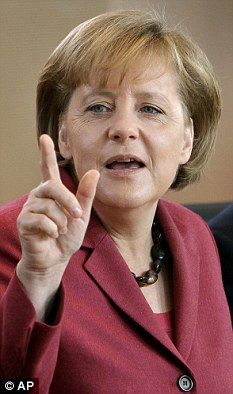
A protest in front of German soldiers and the fate of the dark side of the generosity of their dead colleagues in Afghanistan and the emblem of mourning black Anoahm
Between Cefhata you will find what is new
German soldiers are wearing their hearts on their sleeves - in the form of a badge that protests their country's involvement in the war in Afghanistan.
Some troops have taken to wearing the cloth accessory that states - ironically - 'I fight for Merkel' in a bid to persuade the German Chancellor Angela Merkel to explain exactly what they are fighting and dying for.
Four more troops were killed, and five badly injured, in Afghanistan last week.
Seven soldiers have died there so far this month, bringing the total to 43 in all since they were first deployed eight years ago.
Unable to engage the Taliban directly on the ground, frustrated by their government’s inability to acknowledge they are even engaged in a war and angered by the lack of popular support for their mission, the badges are a low-key mutiny that has sent shock waves through the top brass of the Bundeswehr.
Soldiers were warned this week that it is illegal to sew the cloth patches on to their uniforms.
But that hasn’t stopped them from buying the badges in their hundreds, in desert beige or NATO green, at the ISAF camp at Mazar-e-Sharif.
'They want the Chancellor, their ultimate boss, to finally find the clear words to put the war against the Taliban into black and white,' Bild Zeitung, Germany’s biggest daily paper, said today.
Chancellor Merkel is to make a statement to parliament tomorrow. Her spokesman said she wants to make clear her 'high-esteem' for the work of the German soldiers in Afghanistan in the light of the recent casualties.
But she will be speaking in the Reichstag after being put under pressure from U.S. General Stanley McChrystal, who arrived in Germany today with a brief from the White House to get the Germans to do more in Afghanistan.
Germany has the third largest presence in Afghanistan after the U.S. and Britain. The German parliament approved the dispatch of a further 850 soldiers in February when it extended the mandate for the military mission.
Yet the political will for German troops to engage the enemy head-on remains lacking.
Cracks are growing in the parties that supported their engagement there up until now.
Ottmar Schreiner, a left-wing member of the opposition Social Democratic Party (SPD), said his party has 'growing doubts' about German involvement in Afghanistan.
He said: 'If things haven't improved in Afghanistan by next year then I don't see where a majority for a new extension of the mandate is going to come from.'
The trouble for Mrs Merkel is that German involvement is deeply unpopular with some 80 per cent of the public, who want the troops to come home. Germany’s disastrous wars of the last century have left its public with a deep pacifistic streak.
The German press has been swift to condemn the government for its indecisiveness.
The Financial Times Deutschland said: 'With every dead German soldier in Afghanistan, the calls for an immediate withdrawal grow louder. This reflex shows that the German public is still not clear about the character of the mission.
'The politicians are largely to blame. Since the beginning of the mission eight years ago they suppressed a realistic description of the situation... Deaths, injuries, battles and heavy weaponry -- none of these suit the picture that was painted back then.'
The left-wing Berliner Zeitung said: 'Why are German soldiers in Afghanistan at all? As the chancellor and her government are still sticking to the military mission there it is their duty to explain it. But she has failed to do so.
'This can be explained by her basic attitude - it is only worth talking about problems when they become virulent.
'In the case of Afghanistan this is particularly catastrophic. Because the government has failed to make its case in what is the biggest foreign policy and security policy challenge in the history of the Federal Republic of Germany.'
Subscribe to:
Posts (Atom)

